General English Level 3 V 3
UNIT 02 Entertainment TOPIC 03 What's on?
LANGUAGE FOCUS 03 The present perfect tense
Find out another way to talk about past events.

1 The present perfect tense

Jim and Rose say:
Rose:
Have you been away on holiday? I haven't seen you for weeks.
Jim:
No, I' ve been really busy at work.

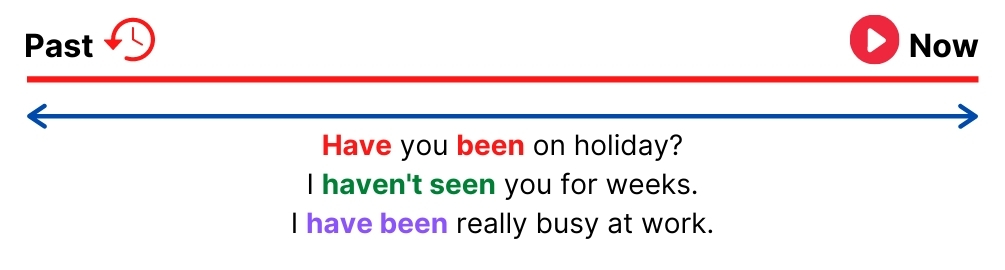
Rose and Jim use the present perfect tense .
We use the present perfect tense to talk about something that started in the past and continues up to now.


When Rose says:
Have you been on holiday?

She means: "Have you been on holiday until now?"

When Rose says:
I haven't seen you for weeks.

She means: "I haven't seen you for weeks up until now."

When Jim says:
I have been really busy at work.

He means: "I was busy at work and I'm still busy now."

We also use the present perfect to talk about things that happened in the recent past, when the exact time is not important.

Examples

I ' ve seen the film.
She 's gone on holidays.
Congratulations! You 've passed the test.

We make the present perfect by using:

Have/has + the past participle


We make questions in the present perfect like this:

Have you been away on holiday?
Has he seen her this week?

We make answers in the present perfect like this:

I
You
We
They
have
haven't
have not
been busy at work.
She
He
has written a love story.
It has
hasn't
has not
taken a long time to get here.

Past participles can be regular or irregular.

Most verbs are regular.
We make past participles for regular verbs by adding -ed

Infinitive Past Participle Present Perfect Tense
play play ed have/has played
talk talk ed have/has talked
work work ed have/has worked

Some verbs are irregular.
Here are some important irregular past participles:

Infinitive Past Participle Present Perfect Tense
be been have/has been
see seen have/has seen
do done have/has done

Go to 03 INFORMATION to find out about the most common irregular past participles.

Examples

1 Read the examples.
2 Listen to each example.
3 Practise saying the lines. Use the Pause button.
Have you been sick?
I haven't been to the beach for months.
I have written a love story.

2 Using ever, never, already and yet.

Rose and Jim are talking:
Rose:
Have you ever been to the International Food Festival?
Jim:
No, I haven't.

' ever ' means at any time in a person's life.

past (from birth)...
__________________________________ ....now
Have you ever been to the food festival?
We can answer:
No, I haven't .
or
No, never.
No, I haven't seen it yet .
or No, not yet .
Yes, I have .
or Yes, I've seen it already .

' Not yet ' means 'not up till now but perhaps some time in the future'.
We often use 'not yet' with the present perfect tense. e.g. "Have you seen Maria yet?" "No, not yet."

Examples

1 Read the examples.
2 Listen to each example.
3 Practise saying the lines. Use the pause button.
Have you ever seen the movie 'Wait for me'?
Yes, I have .

I' ve already seen the movie 'Wait for me'.
Let's see another film, then.

Have you ever been to Japan?
No, never .

Have you ever eaten Korean food?
No, not yet , but I'd love to one day.

Speakers in the United States of America often use the past simple for the present perfect.

Did you ever see the film 'Wait for me'?
No, I didn't.
Yes, I did.

Now go to 04 LANGUAGE FOCUS The present perfect - task.